

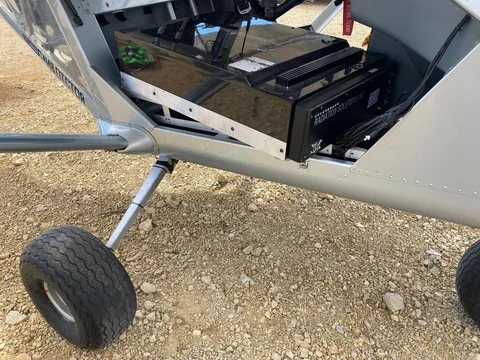
Airborne gamma-ray spectrometry
Airborne gamma-ray spectrometry (AGRS) investigates the area-averaged concentrations of radioactive elements in near-surface rocks and soils, primarily uranium (radium), thorium and potassium. AGRS data are interpreted on the basis of the distribution patterns of radioactive elements in rocks and ore fields.
Principal gamma-ray spectrometer specifications:
- Number of channels: 1024
- Detectors: Polyscin NaI(Tl)
- Spectrometer energy resolution at 0.662 MeV: 9% or better
- Detector volume: up to 48 L (16 L for light aircraft; up to 1 L for UAVs)
- Energy-scale stabilisation: automatic, using the photopeaks of naturally occurring radionuclides
- Separate spectrum acquisition for each crystal
- Gamma-ray spectrum acquisition range: 0.38–5.0 MeV
- Recording interval: 1 s
Main objectives:
- identification of geological features within the survey area;
- exploration for deposits of radioactive minerals;
- investigation of the nature and intensity of overprinting processes (metasomatism), and exploration for hydrothermal deposits;
- remote environmental monitoring, including assessment of radioactive contamination (caesium-137);
- investigation of areas prospective for oil and gas.
AGRS survey and data-processing procedures follow IAEA recommendations (IAEA, 2003). The correction for free radon in the atmosphere is determined using the spectral-ratio method, which tracks changes in the ratio of the area of each photopeak associated with the principal uranium-series emission lines (Bi-214) to the area of the 0.609 MeV photopeak.