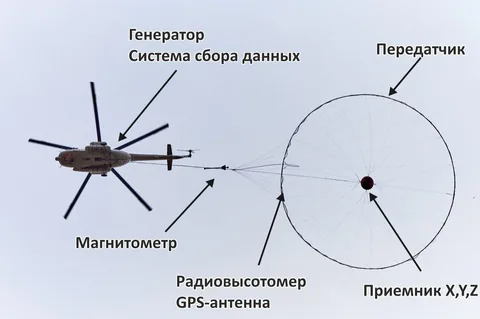
The modern HoriZOND time-domain electromagnetic survey system (QTEM®) employs the transient electromagnetic method, an inductive airborne electromagnetic technique that provides detailed investigation of the geoelectric section both laterally and with depth.
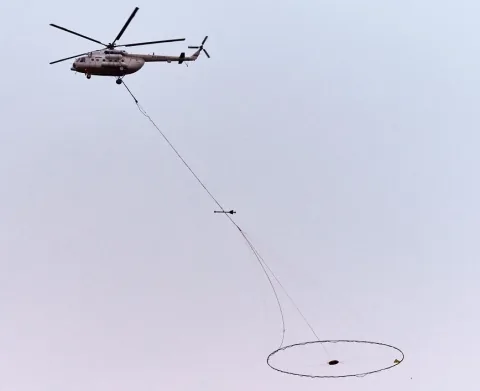
The transient electromagnetic method investigates the decay of the magnetic field generated by eddy currents (transient responses) induced in conductive media during application of the primary magnetic field (on-time) and after it is switched off (off-time). The primary magnetic field is generated by passing current pulses through a closed, horizontal, multiturn loop towed by an aircraft on a tow cable. Transient responses are recorded using differently oriented induction receivers (multiturn coils). The ground-based counterpart is near-field transient electromagnetic (TEM) sounding.
Principal system specifications:
- dipole moment: up to 600,000 A·m²
- transmitter frequency: 12.5–75 Hz
- pulse duration: 9–20 ms
- transmitter: horizontal multiturn loop
- configuration: coaxial
- pulse waveform: trapezoidal
- measured components: X, Y and Z components of dB/dt (induced electromotive force)
- frequency range: 12.5 Hz–25 kHz
- output-component sampling frequency: 10 Hz
Main objectives:
- detailed exploration for sulphide copper–nickel deposits and polymetallic lead–zinc ores;
- investigation of the internal structure of ore-controlling tectonic zones, and tracing of ore-hosting faults laterally and at depth;
- delineation of details within zones of superimposed alteration;
- investigation of shallow geological structure through detailed sounding;
- mapping of palaeovalleys and karst features;
- assessment of the spatial extent of groundwater;
- analysis of the cryogenic state of soils and mapping of permafrost zones;
- production of physical-property maps with geoelectric sections.
Features of the airborne electromagnetic survey system:
- the system can be configured by adjusting its principal parameters to address specific geological objectives;
- investigation depths of up to 500 m can be achieved owing to the large dipole moment and low base frequency;
- reliable detection of weak anomalies owing to the low intrinsic system noise (less than 0.2 nT/s);
- compatible with widely used helicopters, including the Eurocopter AS350 B3 and Mi-8;
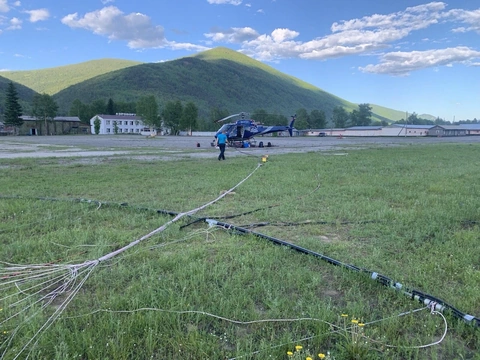
- the transmitter loop comprises lightweight tubular fibreglass segments, facilitating transport, assembly and repair.
The main advantages of the technology are detailed characterisation of the subsurface section, rapid survey operations and integrated analysis of subsurface anomalies of any type.